If an individual seeking asylum has an appeal that is dismissed at the tribunal, or they do not submit an appeal against their asylum decision within the specific period, the Home Office will likely consider that person to be “appeal rights exhausted”, often abbreviated to ARE. On the surface, this may suggest that an individual cannot make any further appeal, but this may not be the case. Individuals may be able to appeal to the Upper Tribunal or submit fresh evidence in the form of a new claim. If an individual fails to meet the deadline to do so, or has their appeal dismissed, they are likely to be considered ARE again. Once the Home Office considers an individual ARE, they may be at risk of detention and/or removal from the UK.
This term is widely criticised as misleading, since a person who is ‘ARE’ may still have legal options or further appeals available to them, despite the label suggesting otherwise. Becoming ARE does not automatically end a person’s asylum support (NASS). Those with a dependant on their asylum claim who is under 18 continue to receive support from the National Asylum Support Service (NASS); those without a dependent will, under most circumstances, have their financial and accommodation support end after 21 days. People who meet certain criteria may instead apply for and receive Section 4 support; this support is not automatic and must be applied for, as people are not normally transferred to it directly from Section 95 support.
Becoming ARE does not mean a person has no further legal options. It is important to get legal advice as soon as possible, so a solicitor can explain the refusal decision and advise on what further applications may be available and what evidence would be needed, including a further asylum application based on new evidence (a fresh claim), a human rights application (for example based on family ties, children in the UK, or medical grounds), or a late appeal where good reasons for missing the original deadline can be shown. Gathering this evidence and preparing further submissions can take weeks or months, during which a person may be without accommodation or financial support, or removed to an immigration removal centre.
People who have exhausted their appeal rights face a higher risk of immigration detention and potential removal from the UK compared to those at earlier stages of the asylum process, though not everyone who reaches this status is detained.
Immigration detention is a government practice in which individuals are held in detention centres while their immigration status is being resolved. The Home Office, rather than judges or legal experts, decides who should and should not be detained. As a result of its poor decision-making, the Home Office has paid at least £50m in compensation for unlawful detention since the start of 2021.
It is a form of administrative detention, not part of the criminal justice system or a punishment. However, conditions in immigration detention closely resemble prison conditions. In most cases, detainees are held in small cells with barred windows, where they are locked up for several hours during the day and at night. Healthcare services are often under-resourced, and access to legal support and contact with friends and family is extremely limited.
Tens of thousands of people are detained each year across several detention centres, also known as Immigration Removal Centres (IRCs), located throughout the country. Scotland is home to one IRC, Dungavel in South Lanarkshire, roughly an hour’s drive from Glasgow, which lacks any bus routes and is over 14 miles from the nearest train station.
A person may be detained under immigration powers at any point, but risk is higher at particular points: on entry or re-entry to the UK, when claiming asylum where the case is categorised as a non-suspensive appeal (usually following the screening interview), once a person is appeal-rights exhausted (ARE), or where a person requires leave to remain but does not have it. Detention can also occur at a routine reporting appointment or outside of any appointment. Immigration Enforcement, the part of the Home Office responsible for immigration checks, detention, and removals, can locate a person at their workplace, home, or in a public place.
A person may initially be held in a short-term holding facility or reporting centre for up to seven days before usually being moved to a longer-term detention centre; some are taken directly to a longer-term centre. The Home Office’s own term for these facilities (IRC) has been criticised as misleading; most people detained are released back into the community rather than removed, while others remain in detention for long periods without ever being removed.
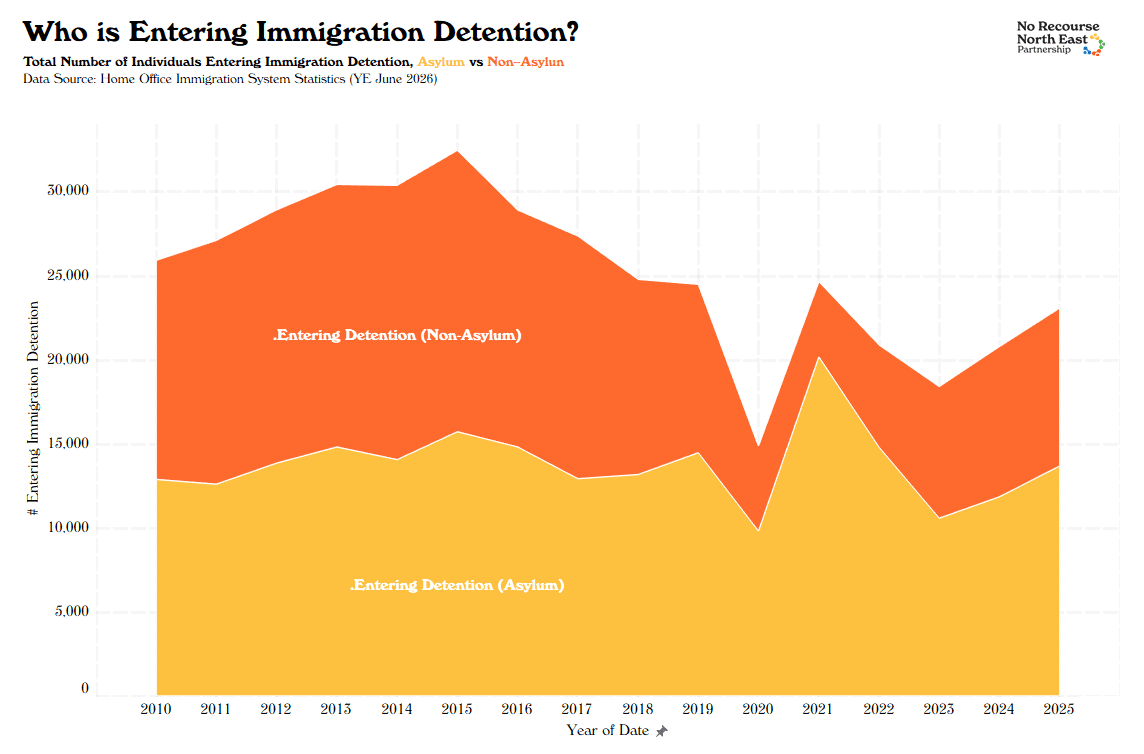
Historically, there has been a rough 50-50 split between those who are seeking asylum and those who are not, entering immigration detention, although this has skewed towards a larger share of people seeking asylum who have become appeals-rights-exhausted post-Brexit, as visualised below.
Detention is stated to be a last resort, usually used shortly before a removal, and is governed by the Detention Centre Rules, which set out minimum safeguards, including access to healthcare, contact with the outside world, and standards for staff conduct. People are often detained a considerable distance from their existing lawyer, and legal aid lawyers face strict limits on the time and travel they can claim.
Since removals and deportations occur almost entirely at London airports, a person detained in Scotland is likely to be transferred to a detention centre in England, which can disrupt their relationship with their existing lawyer. People who claimed asylum or applied for status in Scotland or Northern Ireland may face additional legal aid difficulties, as the system operates differently in England. Scotland offers legal aid for most immigration matters, whereas England and Wales do not.
A person should only be detained for a ‘reasonable period of time’, and only where there is a ‘realistic prospect of removal’, a genuine chance of removal within a reasonable timeframe, which the Home Office is required to review through regular detention reviews. Where removal is unlikely to occur soon, including when travel documents cannot be obtained.
Immigration bail is the primary route by which people in detention are returned to the community, usually with conditions attached. It is not criminal bail: it has nothing to do with being charged or awaiting trial in a criminal court.
Each grant of bail must carry at least one condition: reporting (in person, by phone, or digitally), a residence requirement, a curfew, electronic monitoring, or limits on work or study. People on bail can be detained at a reporting visit, sometimes learning only on arrival that their application has been refused. Missing appointments without explanation can lead to detention, stricter conditions such as a tag, or an asylum claim being treated as “withdrawn”.A person on bail can be returned to detention, for example, when a travel document becomes available and they are set to be removed.
Where a person is being detained pending deportation, which is very rarely the case for those seeking asylum, as elaborated later, an electronic monitoring condition is mandatory unless the Secretary of State considers it impractical or contrary to the person’s Convention rights.
We often hear the word deportation used when discussing people seeking asylum; however, the relevance of deportation is inflated in the asylum context. Deportations most commonly follow a criminal conviction; most people seeking asylum are not deported, as they have not committed a criminal act; seeking asylum is not a criminal offence, and becoming appeals rights exhausted is not a criminal offence. Individuals who are subject to deportation orders are most often foreign-national offenders (FNOs); most FNOs are not and have not tried to seek asylum. This population makes up a large portion of the non-asylum population in immigration detention.
Removal from the UK is subject to specific legal restrictions. It is not standard government policy for an individual who has become ARE to undergo an immediate removal process. A person should not be removed while they have an ongoing asylum claim, that is, while waiting for a decision from the Home Office, unless their claim has been treated as ‘inadmissible’ or is judged ‘obviously hopeless or abusive’. Nor should a person be removed while appealing a refusal of their immigration application or asylum claim, provided they have a right of appeal within the UK; this does not apply where a case has been categorised as a non-suspensive appeal. A person should also not be removed where they have made valid further submissions that the Home Office has not yet decided amount to a fresh claim. It is also advised that an individual should not be removed from the UK if doing so would compromise their human rights and/or breach the UK’s obligations under the Refugee Convention, or the European Convention on Human Rights (ECHR). In these circumstances, Article 3 (Freedom from cruel, inhuman or degrading treatment) and 8 (Right to family and private life) of the ECHR are particularly relevant.
In addition. whilst determining an individual’s eligibility for removal, the relevant authority must consider the following in their human rights assessment: Medical or health needs affecting the person’s ability to travel, lack of travel documents where these cannot be obtained or a lack of funds to arrange a return.
Where a person believes they fall into one of these protected categories but has been notified of removal, they or their lawyer would need to provide evidence of this to the Home Office and request that the removal be stopped; where asylum or human rights grounds apply and have not yet been raised, they need to be raised as soon as possible, including, where relevant, the position of any children involved. Other grounds to challenge removal may exist, including ongoing legal proceedings or a failure to follow the proper removal procedure, and, in some cases, an injunction may be needed to stop a removal.
The fundamental issue with a policy that prioritises detention above all else for individuals who are appeals rights exhausted is that it effectively deprives those who have exhausted their appeal rights or appear to be on a pathway to doing so, any realistic prospect of exercising their entitlement to further legal challenge.
Bail for Immigration Detainees’ summer 2026 report shows as much. The report’s findings include that the large majority of respondents (86%) still lack access to legal representation; that many are not receiving the measures required under HM Prison & Probation Service’s interim policy following SM v The Lord Chancellor’s Department [2021] EWHC 418 (Admin), including £5 weekly payments, information about their right to legally aided immigration advice, and a list of local legal aid immigration advisers; that many prisons show limited awareness of these requirements or report difficulty implementing them; and that respondents feel their lack of legal representation has adversely affected their immigration cases in multiple ways.
As foreshadowed earlier, the geographical and procedural nature of immigration detention for those who exhaust their appeal rights in Scotland further strains any realistic chance of exercising their legal right to appeal/review/claim. Reporting from Dungavel cites frequent and arbitrary transfers across the detention estate, particularly between it and centres in England.
This is particularly troubling given the two countries operate separate legal aid regimes which provide differing levels of coverage for Immigration, Nationality and Asylum cases. Most people in Dungavel facing return are moved to England for removal, which can leave a Scottish solicitor unable to represent them, or too little time to find an English one.
Government ministers have primarily justified detention on the basis that people abscond or evade the authorities if left in the community, but this is described as inaccurate: absconding rates are reported to be extremely low. In the 2020s, the percentage of individuals leaving immigration detention for reasons labelled ‘other’, which includes absconding, has never exceeded 5%. Community-based case-working is reported to produce better outcomes and further reduce absconding, partly because people retain access to support from family, friends and their community.
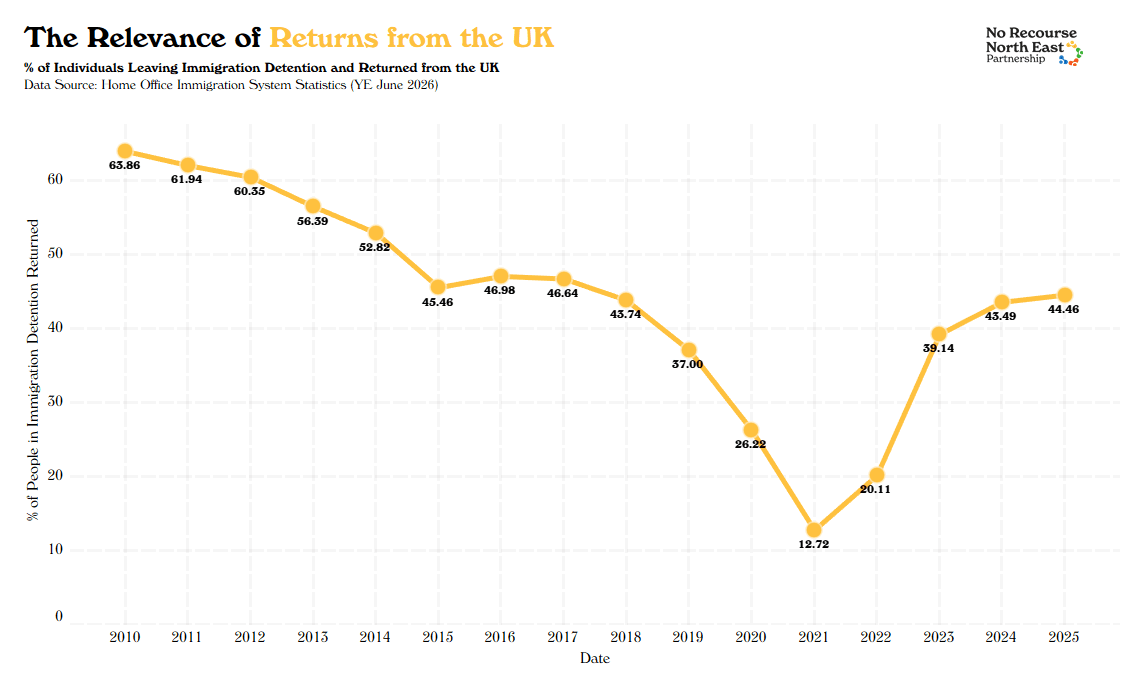
According to government guidance, a key purpose of detention, in addition to flattening the rates of absconding, which, as established earlier, are low, is to effect removal. Yet the percentage of individuals in detention who have actually been removed has ranged from 13% to 44% in the 2020s, falling sharply after the Brexit vote, largely but not exclusively due to COVID-19, as visualised below.
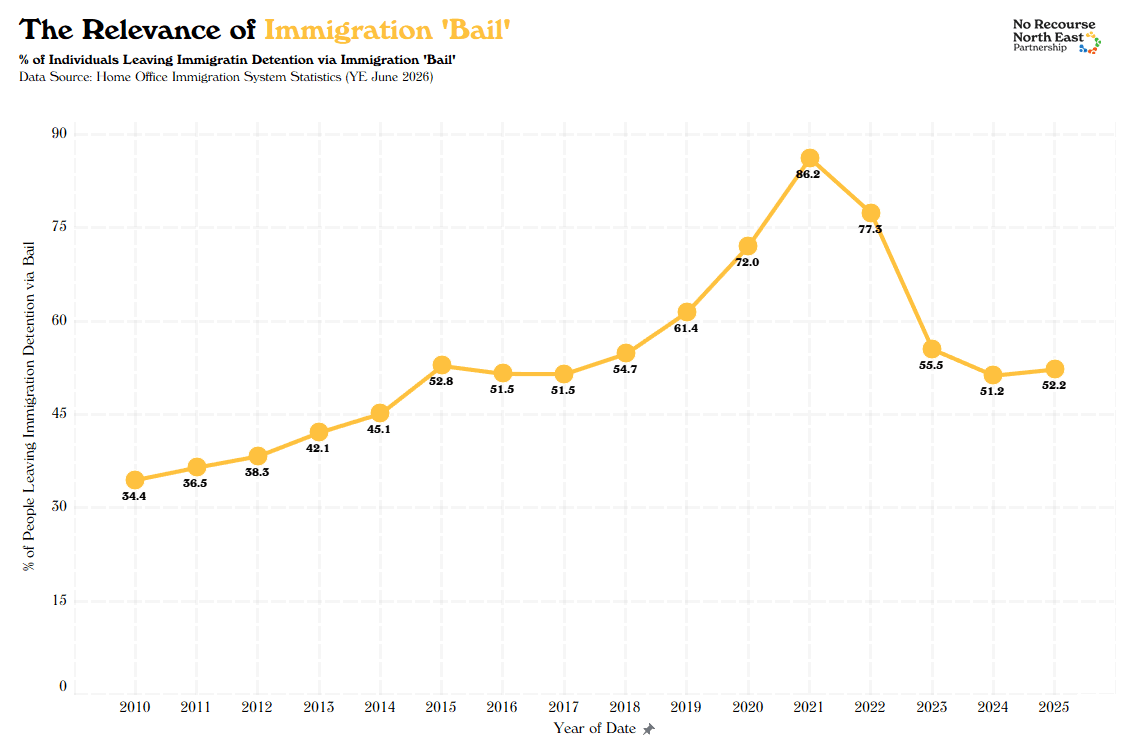
In most cases to date, individuals are ‘bailed’ back into the community. The median share of those doing so since 2010 is around 50%, though it has reached as high as 86% in 2021, as visualised below..
Unusually within Europe, the UK has no time limit on detention. Government guidance states detention should be for the shortest period necessary, yet by YE June 2026 over a third (37.9%) of people leaving detention had been held for more than 28 days, 470 people were released after more than six months, and 52 people were released after stays of over a year.
Nobody entering detention is told in advance how long they will be there. Detention is reported to have a range of harmful impacts, particularly given how many people in detention already have histories of trauma, with a high prevalence of mental health problems and existing conditions worsened by the stress of indefinite detention.
Rule 35 of the Detention Centre Rules 2001 exists to ensure that particularly vulnerable detainees are brought to the attention of those responsible for reviewing their detention. In practice, it does not work as intended. Medical Justice’s casework and research consistently find that GPs working in immigration removal centres do not meet Rule 35 reporting obligations, and that reports under Rule 35(1) and (2) are rarely completed at all.
(1) The medical practitioner shall report to the manager on the case of any detained person whose health is likely to be injuriously affected by continued detention or any conditions of detention.
(2) The medical practitioner shall report to the manager on the case of any detained person he suspects of having suicidal intentions, and the detained person shall be placed under special observation for so long as those suspicions remain, and a record of his treatment and condition shall be kept throughout that time in a manner to be determined by the Secretary of State.
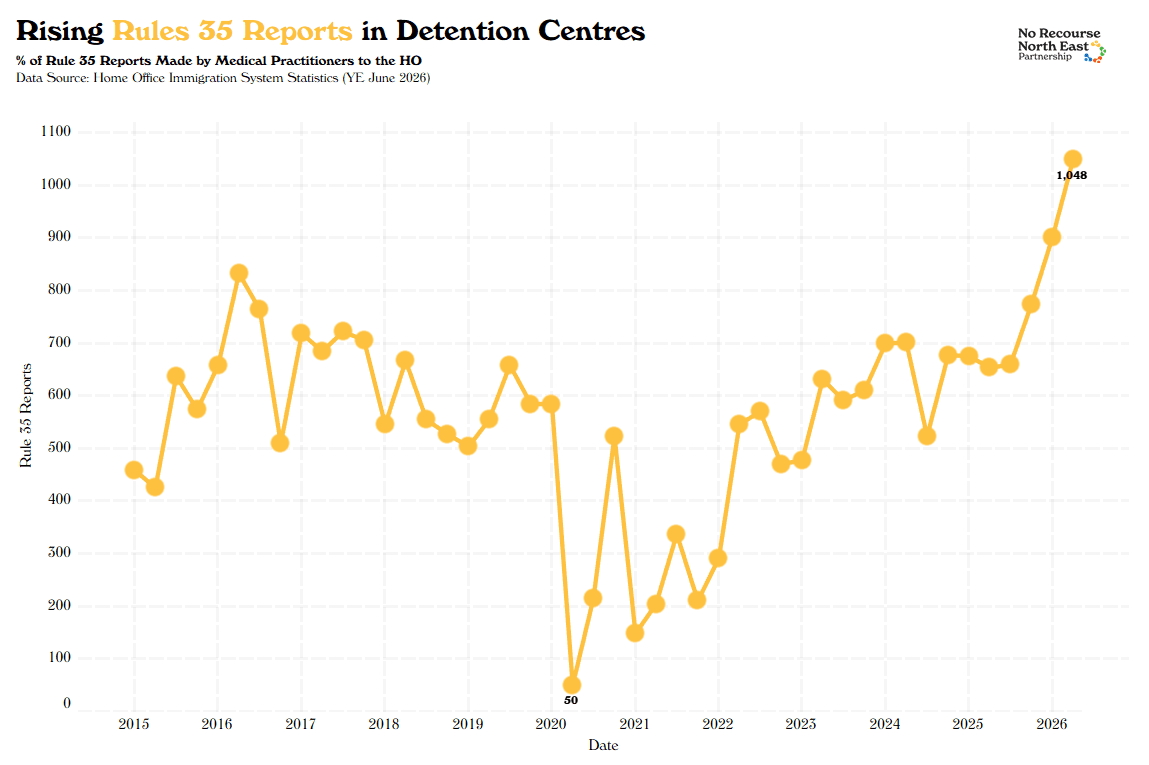
The number of reports made by medical practitioners to the Home Office under rule 35 reached over a thousand (1048) for the first time on record in Q2 2026; with over 1000 distinct individuals (~5% of all detainees) subject to reports related to health concerns, suicide risk or torture allegations, as visualised below.
Rule 40 permits an initial period of segregation of up to 24 hours, extendable to a maximum of 14 days. Rule 42 permits segregation of up to 24 hours, extendable to up to three days on the written direction of an officer of the Secretary of State. Once a decision to segregate has been taken, an IRC doctor must be notified “without delay”.
The conditions that give rise to the abuse and mistreatment of vulnerable people persist in detention. Detainees commonly have complex healthcare needs; detention can exacerbate existing conditions and itself cause mental illness; and the safeguards meant to prevent vulnerable people from entering or remaining in detention are dysfunctional. These factors, combined with staff lacking therapeutic tools who often fail to de-escalate incidents and treat distressed behaviour as refractory, produce an inevitable recourse to coercive measures, including force, to manage mentally unwell detainees.
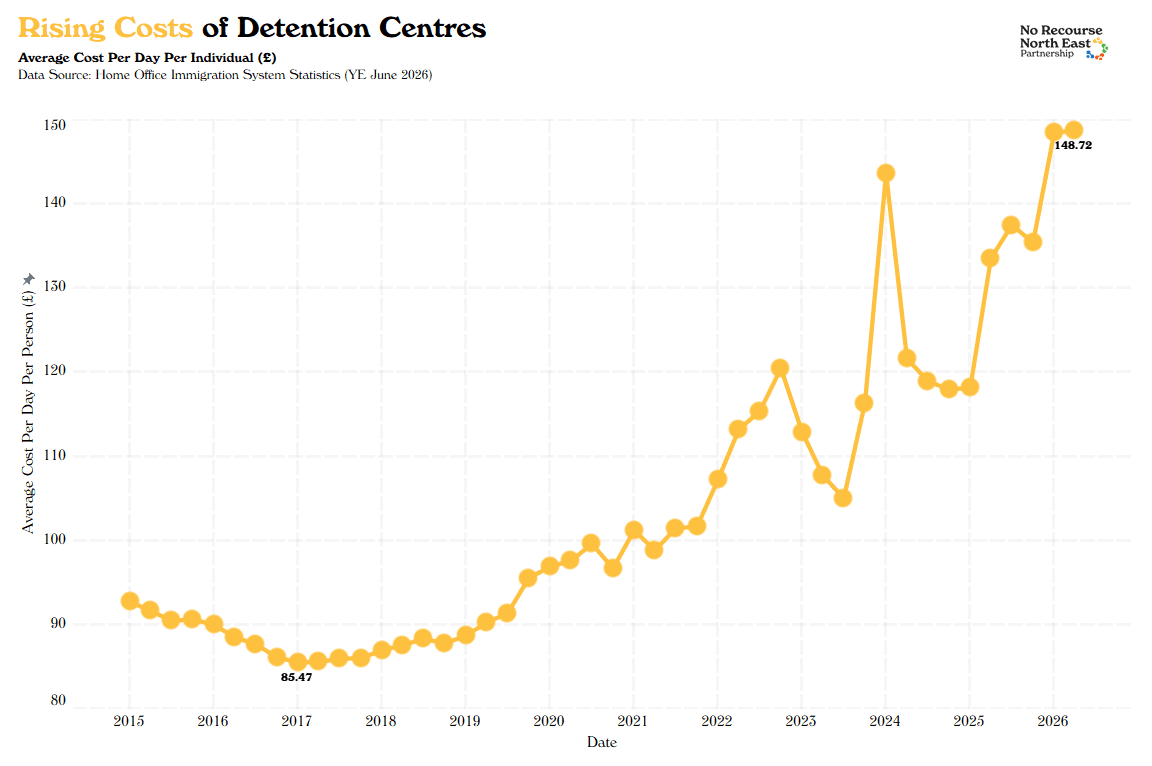
In many cases; detention serves no purpose beyond disruption to the individual, their family, community and legal support, at a public cost that continues to increase, and as of YE June 2026 sits at nearly £150 per person per day, as visualised below.
If you are to write to the Home Office or your MP/MSP we encourage you to push for the following:
The Introduction of a statutory time limit on immigration detention.
The Home Office has previously rejected a 28-day limit on the grounds that it would “severely constrain” immigration control and “put the public at risk”. The evidence does not support that objection: absconding rates are low; most detainees are released rather than removed; and previous analysis has suggested that a 28-day limit would save the taxpayer £30–60 million a year, a potential sum of money that is likely to only have increased given the increased costs of detention since publication. We recommend a statutory 28-day limit, with release at that point unless the Secretary of State can justify continued detention before a judge.
The introduction and expansion of funding for alternative solutions to detention.
Small pilots have already been run by the Home Office, UNHCR, and independent charities, and the evidence they have produced is encouraging.
A UNHCR pilot running from 2019 to 2021 is reported to have proved both more humane and less expensive per day than detention. A two-year pilot run by the King’s Arms Project (the Refugee and Migrant Advice Service), concluding in 2023, is reported to have been two-thirds cheaper than a detention centre and to have resulted in 80% of clients being offered viable options to regularise their immigration status.
These are promising foundations rather than settled proof, and further pilots should be designed to address the methodological criticisms of earlier schemes so that the case for expansion rests on robust evidence. But the direction of travel is clear: alternatives have repeatedly been found more humane and cheaper, and a government spending around £150 per person per day on detention should be funding their introduction and expansion.