The near-total ban on both access to public funds and employment for people seeking asylum is a challenge. People seeking asylum experience the same disadvantages as those with “more secure” visa statuses that carry NRPF. However, unlike most other individuals with NRPF, these experiences of insecurity are almost impossible to avoid. Those seeking asylum are unable to “earn a living”, as they are locked out of the labour market.
As a result, their ability to avoid poverty is limited. The only money that the vast majority of people seeking asylum receive is from the National Asylum Support System (NASS).
Despite what many may suggest, the money provided from the NASS is usually less than £10 per week, the idea that people seeking asylum are provided with lots financial support is a myth. You can understand more about this and other myths by viewing our mythbusting leaflet.
Asylum is clearly defined in the 1951 Refugee Convention, to which the UK is a signatory. Asylum is a claim one makes for international protection. In the UK, individuals and families claim asylum from the Home Office, which is the government department responsible for public safety and policing, border security, immigration and passports. The right to claim asylum is a fundamental human right and is recognised by countries across the globe.
If you are successful in your application, you will be granted leave to remain and may be classed as a refugee. According to the 1951 Refugee Convention, a refugee is someone:
‘owing to well-founded fear of being persecuted for reasons of race, religion, nationality, membership of a particular social group or political opinion, is outside the country of [their] nationality and is unable or, owing to such fear, is unwilling to avail [themself] of the protection of that country; or who, not having a nationality and being outside the country of [their] former habitual residence, is unable or, owing to such fear, is unwilling to return to it’.
Whilst an individual awaits a decision from the Home Office for their claim, they are considered an ‘asylum seeker’, although we prefer the term ‘person seeking asylum’. For an exhaustive answer to this question, please work through Right to Remain’s ‘What is Asylum?’ page in their toolkit and view this short 5-minute video produced by the charity, which introduces asylum.
Individuals and families will seek asylum to escape persecution, war and/or life-threatening danger based on their race, religion, nationality, political opinion or social group. These people will have to prove in their claim that they have a ‘well-founded fear’ of ‘persecution’ should they be returned to their home country.
To learn more about the specific meaning of ‘well-founded fear’ and persecution, please read this explainer from the European Union Agency for Asylum.
Yes, families can and do claim asylum in the UK. They can submit a joint “Family Asylum Claim” if they share the same grounds for fearing persecution. Children under 18 will be listed as dependents on a parent’s claim; they will not receive refugee status unless they make their own claim.
The vast majority of people who claim asylum in the UK are not families. This is due to many reasons, most prominently, the dangerous nature of the journeys most make to claim asylum on British shores. Their family members can apply for a family-reunion visa, although this is currently suspended as of September 2025. For more information on Family Reunion, please read the Home Office’s guidance.
Children who arrive in the UK without an adult are called ‘Unaccompanied Asylum-Seeking Children’ (UASC). UASCs are children who arrived in the UK aged 17 or younger, without a parent or adult and have subsequently claimed asylum. Most unaccompanied children who arrive in the UK to seek asylum do not present with evidence of their age. As a result, the Home Office has a duty to carry out an age assessment to determine whether or not they are, or could be, a child. Local authorities also have a duty to carry out an age assessment when a UASC arrives in their area, even if the Home Office’s initial assessment deemed them an adult.
The importance of the age assessment decision is substantial. The support provided to unaccompanied children and adults seeking asylum is significantly different. COSLA has produced clear guidance detailing the support provided to UASCs. Children deemed to be adults through the age assessment process lose the support detailed in the COSLA guidance. Losing this support increases the risk of further exploitation, isolation and re-traumatisation.
A July 2025 report from the Independent Chief Inspector of Borders and Immigration (ICIBI) noted safeguarding concerns throughout the process. This included cases where children wrongly assessed as adults were forced to share rooms with unknown adult males in asylum accommodation.
People can only claim asylum on British shores
Persons must claim asylum at a ‘designated place’ which is clearly defined in section 14 of the Nationality and Borders Act 2022, including at a port of entry (for example, an airport or port), at an Asylum Intake Unit, or in a removal centre.
Individuals claiming asylum at a port must inform a Border Force officer of their intention to do so. These individuals are then asked to attend a ‘screening interview’ usually within five days of their claim. To learn more about the screening interview, please read this page of Right to Remains’ toolkit.
People who claim at a port are called ‘port asylum seekers’. Individuals who claim asylum after entering the UK must contact the Home Office to arrange an appointment with the Asylum Intake Unit. People who claim once they’ve entered the UK are called ‘in-country asylum seekers’.
The most important thing someone seeking asylum can do is seek immigration advice from a qualified solicitor.
A lot happens, hence the importance of having a lawyer guiding you through the process cannot be understated.
We will provide a summary of what happens; however, read exhaustive guides like this one from Right to Remain and this from the Scottish Refugee Council for more detail.
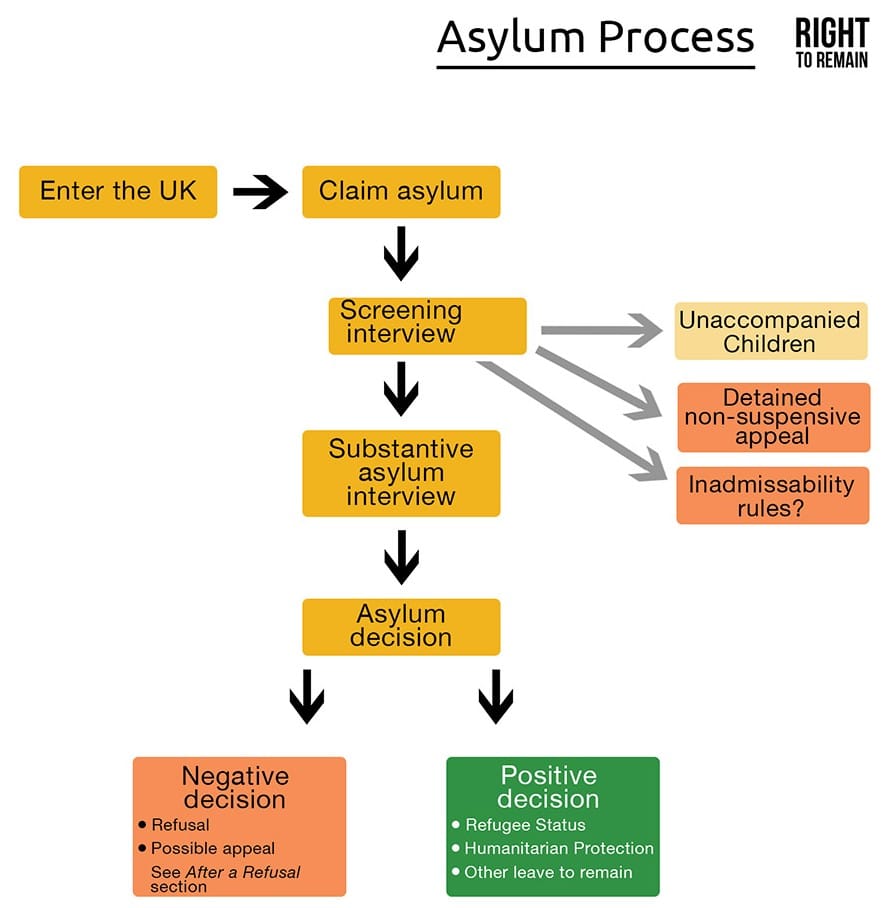
The first thing an individual will be asked to do is attend their first, and shortest, interview, called the ‘Screening Interview‘. In this, you will be asked to provide basic information such as your background, your journey to the UK, and a brief explanation of why you are claiming asylum. If you are claiming asylum alongside family members, they will attend the interview with you. Your Lawyer will not be able to attend. Individuals and families can inform the Home Office if they are destitute and in need of accommodation and financial assistance at the screening interview; the Home Office may be able to provide you with ‘Asylum Support’. You will have no choice in where you are relocated if you need asylum accommodation.
Upon completing the interview, you should be sent an ARC (Application Registration Card). This photo ID will confirm that you have claimed asylum, for more information, see the Home Office website here.
Following your screening interview, you will be asked to participate in a ‘Substantive Interview‘. This interview is far longer and requires people seeking asylum to provide substantial evidence to support their ‘well-founded fear or persecution’ in their home country. This is often called the ‘big’ interview because of its length and depth. You are able to submit further evidence after your substantive interview; it’s incredibly important you seek legal advice if you consider doing so.
Using the evidence provided in your interview, the Home Office will then consider the merits of your asylum claim. If successful, you should be granted refugee status; if unsuccessful, you have the right to appeal. People often have to wait a long time for their asylum claim to be decided, which is distressing, inefficient, and benefits no one involved in the process.
The flowchart below, created by Right to Remain, provides an excellent and easy-to-understand summary of the steps involved.
Immigration bail is a legal procedure used by the Home Office to allow individuals in government custody (this is not because of a criminal offence, but is done so while your right to be in the UK is being resolved) to be released from detention into the community whilst their case is processed.
Immigration bail is a temporary condition of release that carries strict conditions. Individuals may be subject to immigration bail if their status makes them liable to detention; this was previously known as ‘temporary admission’.
Immigration bail may apply to, amongst others, people seeking asylum whose appeal rights have been exhausted. An individual subject to immigration bail will be issued a BAIL 201 letter upon release or upon arrival in the community. This letter is an official Home Office document given to people on immigration bail instead of being detained. It confirms you are allowed to live in the community while your immigration case is being resolved. One of the conditions included in this letter may be restrictions on work, occupation and/or study.
For further guidance, please read the Home Office’s Immigration Bail Guidance for Caseworkers.
The UK government is required to provide accommodation and/or subsistence (money for food, clothing, and toiletries) to prevent asylum seekers from becoming destitute. This is primarily due to legal obligations under Article 3 of the European Convention on Human Rights (ECHR). Article 3 prohibits torture and inhuman/degrading treatment.
Support for people seeking asylum in the UK is authorised by Section 95, Section 98 and Section 4 of the Immigration and Asylum Act 1999.
The three types of asylum support each apply at different stages. Section 95 is the main support for those with an active, ongoing asylum claim who are facing destitution. This usually provides a place in dispersal accommodation and/or a weekly cash allowance. Section 98 is temporary emergency support, usually full board in a hostel or hotel, available to people seeking asylum who are destitute while they wait for a Section 95 decision. Section 4 support applies after an individual’s asylum claim is refused and their appeal rights are exhausted. In this situation, individuals who are destitute and meet additional conditions, such as facing barriers to leaving the UK, will be provided with accommodation and financial support.
Contrary to popular belief, asylum support is significantly lower than mainstream benefits. If you are interested in the myths that shape popular conversation about asylum, please view the mythbusting resource we produced in November 2025.
Answers differ across the activities (work/study/volunteer). Permission will also vary with an individual’s age and situation. A brief summary is provided below. It is best that an individual looking to do any of the following activities, particularly work, seek immigration advice.
Work
The majority of people seeking asylum in the UK will not have the right to work. This is a deliberate policy decision by the UK government. The UK government believes the right to work would create a ‘pull factor’ for people who might otherwise not claim asylum in the UK. They want to create a ‘clear distinction between economic migration and asylum’.
Before 2002, people seeking asylum were given the ability to apply for permission to work. They were allowed to do so once the time they had waited for a decision had passed 6 months, and said delay was not their fault; this was extended to 12 months in 2005. This changed in 2010, when the government introduced the Shortage of Occupation List, now the Immigration Salary List. This document listed all roles that people seeking asylum are entitled to work in, provided they meet the time criteria.
If an individuals permission to work was submitted before the 26th of March 2026 and subsequently granted, they can only find employment in roles listed on the Immigration Salary List. If a request for permission was submitted after the 26th of March 2026, then they can find can work in roles listed in the Appendix Skilled Occupations, provided they are qualified at RQF Level 6 or above. If an individual is interested in requesting permission to work, it is important that they do so with guidance from a qualified legal professional.
In a May 2026 FOI publication, the Scottish Government laid out there opinion that people seeking asylum should be able to work after 6 months, not 12:
“The Scottish Government believes that people seeking asylum should have the right to work after six months in the UK … Right to work would enable people to use and develop their skills, make connections in a work environment, help to support themselves and their families, contribute to our economy and restore people’s dignity.”
If an individual who was legally resident in the UK has made an asylum claim, they should be able to continue their work so long as the claim was made whilst their original visa was valid.
Volunteer
People seeking asylum can volunteer for a charity or public sector organisation, provided the volunteering is unpaid and not a substitute for paid employment. The Home Office encourages people seeking asylum to volunteer where possible while their claim is pending. By volunteering, individuals can build a network of connections, improve their language skills, and remain sharp, increasing their chances of employment if they are granted refugee status.
Volunteer Aberdeen hosts an excellent resource which shares opportunities for those interested across the city
Study
In the context of asylum, ‘study’ is taken to mean primary and secondary school for children and young adults up to and including the age of 18, and courses which may lead to a qualification for adults, including English for Speakers of Other Languages (ESOL) courses.
There is nothing in the Immigration Rules that prevents people seeking asylum from studying. People seeking asylum who are subject to immigration bail may have a condition prohibiting study. This is often the case when an individual’s appeal rights are exhausted. Children who are dependents of asylum claims or have made claims in their own right are entitled to education until the age of 18, and so should be set a bail condition permitting study. Home Office decision-makers can require a child to attend a specific, named school to ensure the family remains in their allocated location.
If the Home Office has accepted an individuals claim for protection in the UK
If the Home Office has agreed with your claim for protection in the UK, you will receive a ‘positive decision’ and will have recourse to public funds. In this instance, you will be granted leave to remain, this may be in the form of: refugee status, humanitarian protection or discretionary leave to remain
For more information about your rights once you have been granted a positive decision and the difference between the three types of leave to remain, please visit the Scottish Refugee Council’s online guide for new refugees.
If the Home Office has refused an individuals claim for protection in the UK
If the Home Office has disagreed with your claim for protection in the UK, you will receive a ‘negative decision’. You should immediately seek legal advice. Individuals may be able to appeal their decision. By appealing, an individual is asking an independent judge at an immigration tribunal to review their case. Individuals and/or their legal representative will be given the opportunity to explain and provide evidence as to why the negative decision was the wrong decision. The judge can either allow or dismiss an appeal. On certain occasions, the tribunal may ask the Home Office for a new decision.
In the case that an appeal is dismissed at the tribunal, or an individual does not make a claim within the specific time period, the Home Office will likely consider that person to be “appeal rights exhausted“. On the surface, this may suggest that an individual cannot make any further appeal, but this may not be the case. Individuals may be able to appeal to the Upper Tribunal. Should an invdividual fail to meet the deadline to do so, or have their appeal dismissed by them, then they are are also likely to be considered “appeals rights exhausted”. Once the Home Office considers an individual “appeal rights exhausted”, it is likely that any financial and accommodation support provided by the NASS will cease, and they may be at risk of detention and/or removal from the UK.
Should an individual appeal rights become exhausted, it is pivotal that they seek legal advice. For more information, please view this page by Right to Remain and this page by the Scottish Refugee Council. The former has produced a clear and easy-to-understand animated video that details the process after an asylum refusal
If you work in this space and are interested in learning more and contributing to the design of best practices and policies to help people seeking asylum with NRPF in the North East, then you should consider joining our NRPF and Asylum working group. This is one of three working groups hosted by the partnership. This group meets every 6-8 weeks, with meetings lasting around two hours.
If you are interested in participating or would like to know more about the group and how it functions, please get in touch with [email protected]